
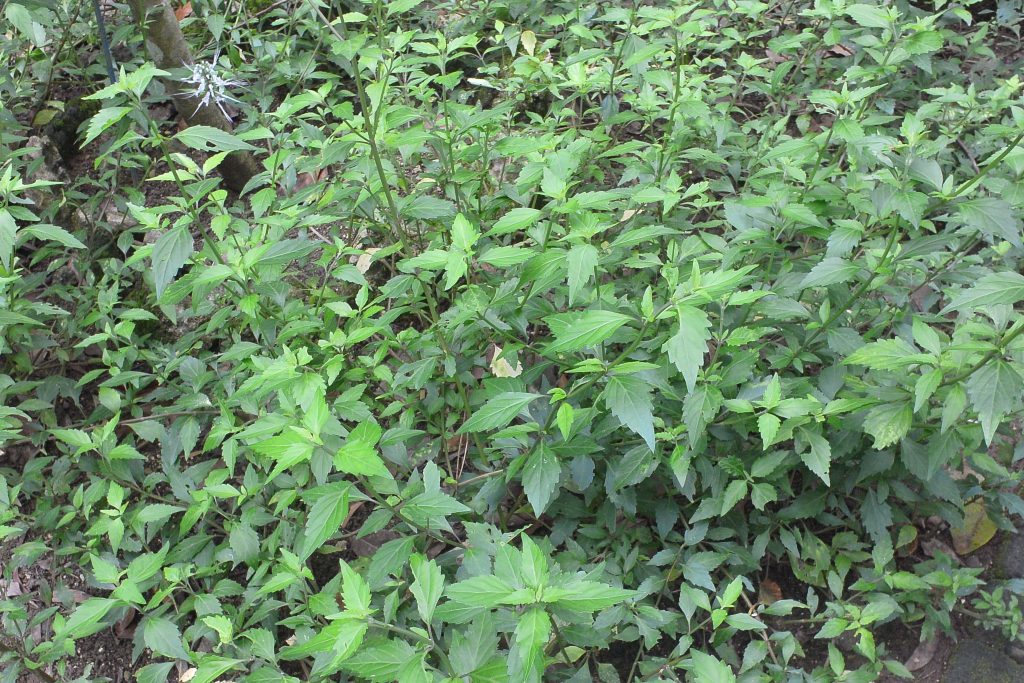
Nama Tumbuhan
Kumis Kucing (Orthosiphon aristatus Blume Miq)
Taksonomi Tumbuhan
- Kingdom : Plantae
- Subkingdom : Tracheobionta
- Superdivisi : Spermatophyta
- Divisi : Streptophyta
- Kelas : Equisetopsida
- Subkelas : Magnoliidae
- Ordo : Lamiales
- Famili : Lamiaceae
- Genus : Orthosiphon
- Spesies : Orthosiphon aristatus (Blume) Miq
(Marjoni M. R., 2017)
Definisi Umum
Kumis kucing adalah tumbuhan yang memiliki benang sari bunganya yang panjang dan menjulur dari dua sisi yang berbeda sehingga mirip dengan kumis kucing (Dillasamola et al., 2023). Persebaran Kumis kucing dapat ditemukan di Asia Tenggara, seperti di Indonesia, Malaysia, Thailand, Vietnam, dan Myamar (Septyani & Shinta, 2021). Nama daerah tanaman ini di Indonesi berbeda-beda penyebutannya di Sumatera dikenal dengan sebutan giri-giri marah, di Sunda dikenal dengan kumis ucing, di Madura dikenal dengan nama songkot koceng (Surahmaida & Umarudin, 2019).
Kumis kucing merupakan tumbuhan habitus berupa semak, tahunan, tinggi 50-150 cm. Batang berkayu, segi empat, beruas, bercabang, coklat kehijauan. Daun tunggal, bulat telur, panjang 7-10 cm, lebar 8-50 cm, tepi bergerigi, ujung dan pangkal runcing, tipis, hijau. Bunga majemuk, bentuk malai, di ujung ranting dan cabang, kelopak berlekatan, ujung terbagi empat, hijau, benang sari empat, kepala sari ungu, putik satu, putih, mahkota bentuk bibir, putih. Buah kotak, bulat telur, masih muda hijau setelah tua coklat. Biji kecil, masih muda hijau setelah tua hitam. Akar tunggang, putih kotor (Aspan & Sherley, 2008).
Kandungan
Senyawa aktif yang terkandung dalam tanaman kumis kucing berupa senyawa flavonoid, saponin, tanin dan steroid (Mutia et al., 2024). Fenol hidrokuinon, alkaloid, polifenol dan triterpenoid merupakan senyawa aktif lainnya yang terkadung dalam sembung (Nurcholis et al., 2022). Sinensetin, orthosiphol, kalium, minyak atsiri, orthosiphonin glikosida, sapofonin, dan mioinositol (Faramayuda et al., 2021).
Khasiat
Kumis kucing berkhasiat sebagai penurun asam urat, penurun tekanan darah, anti-inflamasi, penurun suhu tubuh, diabetes dan penghancur batu kandung kemih (Mutia et al., 2024). Selain itu, kumis kucing bisa digunakan sebagai antioksidan, antibakteri, antivirus, antiradang, antialergi, dan antikanker (Nurcholis et al., 2022).
Cara Pengolahan
Pengolahan daun kumis kucing dengan cara merebus sebanyak 5 helai daun kumis kucing, dengan air 200 ml, didihkan hingga tersisa 100 ml. Setelah di angkat, dinginkan, lalu disaring, meminum sebanyak 2 kali sehari selama 7 hari berturut-turut dengan dosis masing-masing setengah gelas (Yasin et al., 2023).
Daftar Pustaka
- Aspan, R., & Sherley, S. (2008). Taksonomi Koleksi Tanaman Obat Kebun Tanaman Obat Citeureup (R. Napitupulu, L. S. Wisaksono, E. Efizal, L. Mooduta, T. Herawaty, A. Novianti, S. Wahyu, & T. Tumino (ed.)). Badan Pengawasan Obat dan Makanan Republik Indonesia.
- Dillasamola, D., Yanri, D., & Nurlatifah, N. (2023). TUMBUH-TUMBUHAN OBAT DI SEKITAR KITA (D. Dillasamola (ed.); 1 ed.). Penerbit Adab. https://books.google.co.id/books?id=SVLVEAAAQBAJ
- Faramayuda, F., Riyanti, S., Pratiwi, A. S., Mariani, T. S., Elfahmi, E., & Sukrasno, S. (2021). Isolasi Sinensetin dari Kumis Kucing (Orthosiphon aristatus Blume miq.) Varietas Putih. Journal of Pharmaceutical Science and Clinical Research, 6(2), 111. https://doi.org/10.20961/jpscr.v6i2.48084
- Mutia, S., Mulatasih, E. R., Yulyuswarni, Y., & Julaiha, S. (2024). Uji Mutu Ekstrak Etanol Daun Kumis Kucing ( Orthosiphon Aristatus ( Blume ) Miq ) Quality Test of Ethanol Extract of Cat ’ s Whisker Leaves ( Orthosiphon aristatus ( Blume ) Miq ). Journal of Pharmaceutical Sciences and Technology, 1(1), 17–25.
- Nurcholis, W., Mahendra, F. R., Gultom, M. F., Khoirunnisa, S., Kurnia, M. A. C., & Harahap, H. H. (2022). Skrining Fitokimia , Antioksidan , dan Antibakteri Ekstrak Daun Orthosiphon stamineus Dua Senotipe. Jurnal Jamu Indonesia, 7, 121–129. https://doi.org/https://doi.org/10.29244/jji.v7i3.280
- Septyani, L. V., & Shinta, N. P. M. A. (2021). Kandungan Fitokimia Aktivitas Farmakologi Orthosiphon aristatus. Jurnal Media Farmasi, 17(1), 62. https://doi.org/10.32382/mf.v17i1.2048\
- Surahmaida, S., & Umarudin, U. (2019). Aplikasi Miana, Kemangi, dan Kumis Kucing Sebagai Pestisida Nabati (R. N. H (ed.); 1 ed.). Penerbit Graniti. https://books.google.co.id/books?id=0ggPEAAAQBAJ
- Yasin, L. R., Febriyona, N. R., & Sudirman, N. A. N. A. (2023). Pengaruh Air Rebusan Kumis Kucing Terhadap Penurunan Asam Urat di Desa Manawa Kecamatan Patilanggo. Jurnal Rumput Ilmu Kesehatan, 3(1).
Kumis Kucing (Orthosiphon aristatus Blume Miq)
Plant Name
Cat’s Whiskers (Orthosiphon aristatus Blume Miq)
Plant Taxonomy
Kingdom: Plantae
Subkingdom: Tracheobionta
Superdivision: Spermatophyta
Division: Streptophyta
Class: Equisetopsida
Subclass: Magnoliidae
Order: Lamiales
Family: Lamiaceae
Genus: Orthosiphon
Species: Orthosiphon aristatus (Blume) Miq
(Marjoni M. R., 2017)
General Definition
Cat’s whiskers is a plant that has long flower stamens that extend from two different sides, making it look like a cat’s whiskers (Dillasamola et al., 2023). Cat’s whiskers can be found in Southeast Asia, such as Indonesia, Malaysia, Thailand, Vietnam, and Myanmar (Septyani & Shinta, 2021). The local names for this plant in Indonesia vary: in Sumatra it is known as giri-giri marah, in Sunda as kumis ucing, and in Madura as songkot koceng (Surahmaida & Umarudin, 2019).
Cat’s whiskers is a shrub-like perennial plant, standing 50-150 cm tall. Its stem is woody, square-shaped, jointed, branched, and greenish-brown. The leaves are single, oval, 7-10 cm long, 8-50 cm wide, serrated edges, pointed tips and bases, thin, and green. The flowers are compound, forming spikes at the tips of branches, with fused green sepals split into four, four stamens with purple anthers, one white pistil, and a lip-shaped white corolla. The fruit is a capsule, oval, green when young, turning brown when mature. Seeds are small, green when young, turning black when mature. The plant has a taproot, dirty white in color (Aspan & Sherley, 2008).
Contents
The active compounds found in the cat whiskers plant include flavonoids, saponins, tannins, and steroids (Mutia et al., 2024). Hydroquinone phenols, alkaloids, polyphenols, and triterpenoids are other active compounds present in sembung (Nurcholis et al., 2022). Sinensetin, orthosiphol, potassium, essential oils, orthosiphonin glycosides, sapofonin, and myo-inositol (Faramayuda et al., 2021).
Benefits
Cat whiskers are useful for lowering uric acid, reducing blood pressure, acting as an anti-inflammatory, lowering body temperature, managing diabetes, and breaking down bladder stones (Mutia et al., 2024). Besides that, cat whiskers can also be used as an antioxidant, antibacterial, antiviral, anti-inflammatory, anti-allergic, and anti-cancer agent (Nurcholis et al., 2022).
How to Prepare
To prepare cat’s whiskers leaves, boil 5 leaves of cat’s whiskers in 200 ml of water until only 100 ml remains. After removing from heat, let it cool, then strain it, and drink it twice a day for 7 consecutive days, with each dose being half a glass (Yasin et al., 2023).
References
Aspan, R., & Sherley, S. (2008). Taxonomy of Medicinal Plant Collections at Citeureup Medicinal Plant Garden (R. Napitupulu, L. S. Wisaksono, E. Efizal, L. Mooduta, T. Herawaty, A. Novianti, S. Wahyu, & T. Tumino (eds.)). National Agency of Drug and Food Control of the Republic of Indonesia.
Dillasamola, D., Yanri, D., & Nurlatifah, N. (2023). MEDICINAL PLANTS AROUND US (D. Dillasamola (ed.); 1st ed.). Adab Publisher. https://books.google.co.id/books?id=SVLVEAAAQBAJ
Faramayuda, F., Riyanti, S., Pratiwi, A. S., Mariani, T. S., Elfahmi, E., & Sukrasno, S. (2021). Isolation of Sinensetin from Cat’s Whiskers (Orthosiphon aristatus Blume miq.) White Variety. Journal of Pharmaceutical Science and Clinical Research, 6(2), 111. https://doi.org/10.20961/jpscr.v6i2.48084
Mutia, S., Mulatasih, E. R., Yulyuswarni, Y., & Julaiha, S. (2024). Quality Test of Ethanol Extract of Cat’s Whisker Leaves (Orthosiphon Aristatus (Blume) Miq). Journal of Pharmaceutical Sciences and Technology, 1(1), 17–25.
Nurcholis, W., Mahendra, F. R., Gultom, M. F., Khoirunnisa, S., Kurnia, M. A. C., & Harahap, H. H. (2022). Phytochemical, Antioxidant, and Antibacterial Screening of Orthosiphon stamineus Leaf Extract of Two Senotypes. Indonesian Jamu Journal, 7, 121–129. https://doi.org/https://doi.org/10.29244/jji.v7i3.280
Septyani, L. V., & Shinta, N. P. M. A. (2021). Phytochemical Content and Pharmacological Activity of Orthosiphon aristatus. Pharmacy Media Journal, 17(1), 62. https://doi.org/10.32382/mf.v17i1.2048
Surahmaida, S., & Umarudin, U. (2019). Application of Miana, Basil, and Cat’s Whiskers as Plant-Based Pesticides (R. N. H (ed.); 1st ed.). Graniti Publisher. https://books.google.co.id/books?id=0ggPEAAAQBAJ
Yasin, L. R., Febriyona, N. R., & Sudirman, N. A. N. A. (2023). The Effect of Cat’s Whiskers Boiled Water on Reducing Uric Acid in Manawa Village, Patilanggo District. Journal of Health Science Grass, 3(1).