
Nama Latin
Pilea cadierei
Taksonomi
| Kindom: | Plantae |
| Devisi: | Magnoliophyta |
| Kelas: | Magnoliopsida |
| Ordo: | Rosales |
| Famili: | Urticaceae |
| Genus: | Pilea |
| Spesies: | Pilea cadierei Gagnep & Guillaumin |
Definisi Umum
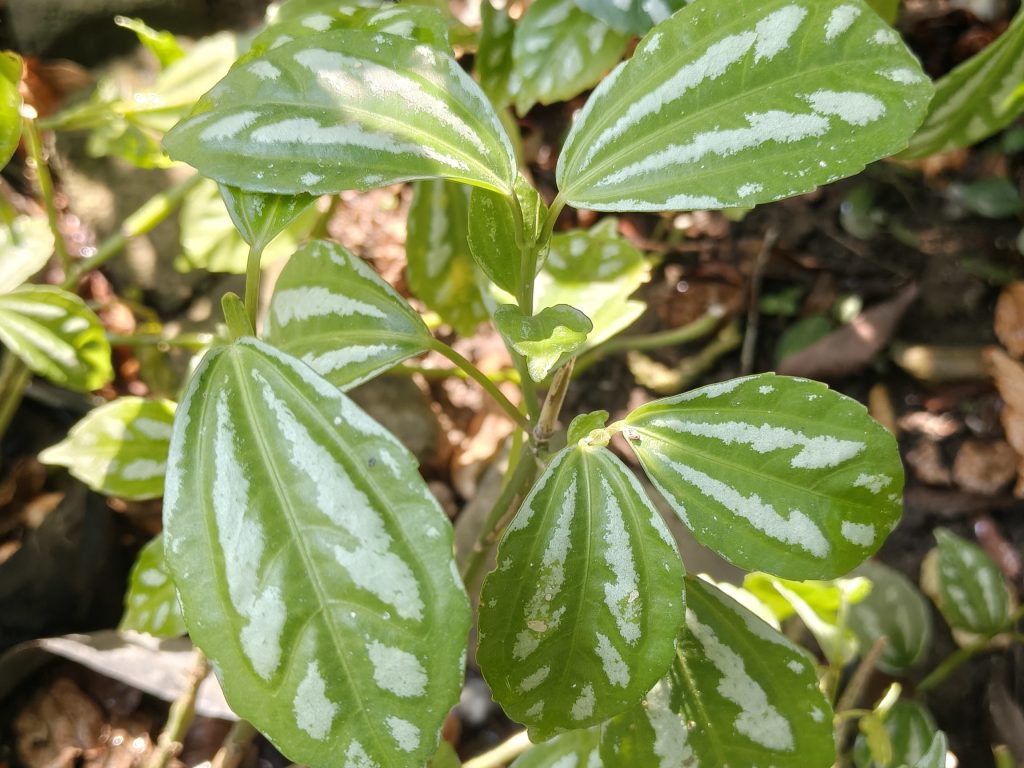
Pilea cadierei merupakan tanaman herba dengan tinggi sekitar 50 cm yang memiliki akar tunggang, batang tegak berbentuk bulat, dan daun tunggal yang tersusun berhadapan bersilang. Daunnya berbentuk elips hingga bulat telur terbalik, berwarna hijau, dengan permukaan halus, licin, dan mengkilap serta memiliki ciri khas berupa noda berwarna abu-abu atau perak pada bagian tengah daun. Bunganya merupakan bunga majemuk yang tumbuh di ketiak daun, sedangkan buah dan bijinya jarang ditemukan (Kementrian Kesehatan Republik Indonesia, 2017). Tanaman ini memiliki kemampuan beradaptasi terhadap kondisi lingkungan dan diketahui berasal dari daerah pegunungan di Vietnam bagian tengah (Yang et al., 2011). Dalam pemanfaatannya, Pilea cadierei juga dikenal dalam pengobatan tradisional Tiongkok (Zaichang et al., 2013).
Kandungan
Daun Pilea cadierei dilaporkan mengandung proanthocyanidin (PA), yaitu kelompok polifenol atau tanin terkondensasi yang tersusun atas dua atau lebih unit flavan-3-ol. Proanthocyanidin dapat dikelompokkan menjadi procyanidin dan prodelphinidin. Pada daun Pilea cadierei, lebih dari 90% proanthocyanidin dilaporkan berada dalam bentuk tidak larut (insoluble proanthocyanidins) (Girard et al., 2020). Selain kandungan tersebut, pada daun dan ruas batang P. cadierei ditemukan struktur cystolith yang terutama tersusun dari mikrofibril selulosa, pektin, dan polisakarida dinding sel serta mengandung garam anorganik, terutama kalsium karbonat. Sebagian cystolith juga dilaporkan mengandung silikon (Watt et al., 1987).
Khasiat
Pilea cadierei secara tradisional dimanfaatkan sebagai tumbuhan obat untuk membantu mengatasi beberapa gangguan kesehatan. Berdasarkan buku Acuan Bahan Baku Obat Tradisional dari Tumbuhan Obat Indonesia yang diterbitkan oleh Kementerian Kesehatan Republik Indonesia (2017), Pilea cadierei digunakan untuk membantu mengatasi susah buang air besar. Selain penggunaan tersebut, Pilea cadierei juga dilaporkan dalam pengobatan tradisional Tiongkok untuk membantu menangani infeksi saluran kemih. Penelitian oleh Zaichang et al. (2013) menunjukkan bahwa ekstrak Pilea cadierei memiliki aktivitas anti-biofilm terhadap Escherichia coli secara in vitro. Aktivitas tersebut diduga berkaitan dengan pemanfaatannya secara tradisional untuk infeksi saluran kemih. Meskipun demikian, penelitian lebih lanjut masih diperlukan untuk menguji aktivitas tersebut pada model hewan.
Cara Pengolahan
Pilea cadierei dapat dimanfaatkan dalam bentuk bahan tanaman maupun hasil ekstraksi. Beberapa bentuk pengolahannya antara lain:
- Sediaan ekstrak
Pilea cadierei dapat diolah menjadi ekstrak tanaman. Zaichang et al. (2013) menggunakan seluruh tanaman yang telah dikeringkan dan mengekstraksinya menggunakan etanol. Ekstrak yang diperoleh kemudian digunakan untuk menguji aktivitas anti-biofilm terhadap Escherichia coli.
Daftar Pustaka
Girard, M., Lehtimäki, A., Bee, G., Dohme-Meier, F., Karonen, M., & Salminen, J.-P. (2020). Changes in feed proanthocyanidin profiles during silage production and digestion by lamb. Molecules, 25(24), 5887. https://doi.org/10.3390/molecules25245887
Kementerian Kesehatan Republik Indonesia. (2017). Acuan bahan baku obat tradisional dari tumbuhan obat di Indonesia. Kementerian Kesehatan Republik Indonesia.
Watt, W. M., Morrell, C. K., Smith, D. L., & Steer, M. W. (1987). Cystolith development and structure in Pilea cadierei (Urticaceae). Annals of Botany, 60(1), 71–84. https://doi.org/10.1093/oxfordjournals.aob.a087424
Yang, L., Li, Y., Yang, X., Xiao, H., Peng, H., & Deng, S. (2011). Effects of iron plaque on phosphorus uptake by Pilea cadierei cultured in constructed wetland. Procedia Environmental Sciences, 11, 1508–1512. https://doi.org/10.1016/j.proenv.2011.12.227
Zaichang, Y., Du, R., Zhang, J., & Li, Q. (2013). In Vitro Anti-Biofilm Activity of The Extract Of Pilea Cadierei. Asian Journal of Pharmaceutical Research and Development, 1(1), 53–57. https://ajprd.com/index.php/journal/article/view/11
Latin Name
Pilea cadierei
Taxonomy
| Kindom: | Plantae |
| Devisi: | Magnoliophyta |
| Class: | Magnoliopsida |
| Ordo: | Rosales |
| Family: | Urticaceae |
| Genus: | Pilea |
| Species: | Pilea cadierei Gagnep & Guillaumin |
General Definition
Pilea cadierei is a herbaceous plant that can grow up to approximately 50 cm tall. It has a taproot, an erect and round stem, and simple leaves arranged in an opposite and decussate pattern. The leaves are elliptic to broadly ovate, green in color, with a smooth, glossy surface, and are characterized by distinctive grayish-white or silvery spots in the middle of the leaf. The flowers are compound flowers that grow in the leaf axils, while the fruits and seeds are rarely found (Ministry of Health of the Republic of Indonesia, 2017). This plant is adaptable to environmental conditions and is known to originate from mountainous regions of central Vietnam (Yang et al., 2011). In terms of its utilization, Pilea cadierei is also known in traditional Chinese medicine (Zaichang et al., 2013).
Chemical Constituents
The leaves of Pilea cadierei are reported to contain proanthocyanidins (PA), a group of polyphenols or condensed tannins composed of two or more flavan-3-ol units. Proanthocyanidins can be classified into procyanidins and prodelphinidins. More than 90% of the proanthocyanidins reported in Pilea cadierei leaves are present in an insoluble form (insoluble proanthocyanidins) (Girard et al., 2020). In addition to these compounds, the leaves and stems of P. cadierei contain cystoliths, which are structures composed of cellulose microfibrils, pectin, and polysaccharides within the cell wall, and contain inorganic salts, particularly calcium carbonate. Some cystoliths have also been reported to contain silicon (Watt et al., 1987).
Medicinal Benefits
Pilea cadierei has traditionally been used as a medicinal plant to help treat several health conditions. According to the book Reference for Raw Materials of Traditional Medicines from Indonesian Medicinal Plants, published by the Ministry of Health of the Republic of Indonesia (2017), Pilea cadierei is used to help relieve constipation. In addition to this use, Pilea cadierei has also been reported in traditional Chinese medicine to help treat urinary tract infections. Research by Zaichang et al. (2013) showed that Pilea cadierei extract exhibited anti-biofilm activity against Escherichia coli in vitro. This activity is thought to be associated with its traditional use for treating urinary tract infections. However, further research is still needed to evaluate this activity in animal models.
Processing Methods
Pilea cadierei can be utilized in the form of raw plant material or as an extract. Several forms of processing include:
1. Plant Extract
Pilea cadierei can be processed into a plant extract. Zaichang et al. (2013) used the whole plant, which was first dried and then extracted using ethanol. The resulting extract was subsequently used to evaluate its anti-biofilm activity against Escherichia coli.