
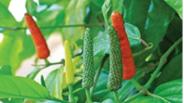
Nama Tumbuhan
Cabe jawa (Piper retrofractum Vahl)
Taksonomi Tumbuhan
Kingdom : Plantae
Divisi : Magnoliophyta
Kelas : Magnoliopsida
Ordo : Piperales
Famili : Piperaceae
Genus : Piper
Spesies : Piper retrofractum Vahl
(Cronquist, 1981)
Definisi Umum
Cabe jawa (Piper retrofractum Vahl) merupakan salah satu jenis tanaman obat yang banyak digunakan di Indonesia serta telah terbukti memiliki efek analgesik yang terdapat pada ekstrak etanol yang terdapat di dalamnya. Cabe jawa secara empiris digunakan oleh masyarakat sebagai analgetik, antipiretik, mencegah mulas, stimulansia, sakit gigi, dan lain lain (Muslichah, 2011). Cabe jawa tumbuh di seluruh wilayah Indonesia pada daerah dengan ketinggian 1-600 m dari permukaan air laut dengan suhu udara 20-30°C. Tanaman cabe jawa dapat tumbuh di tanah lempung berpasir dengan struktur tanah gembur dan berdrainase baik (Evizal, 2013). Tanaman cabe jawa merupakan tanaman perdu dengan tinggi tanaman 0,5-7 m. Akarnya berbentuk bulat dan berwarna cokelat. Batang berbentuk bulat, bersulur, beruas, memiliki akar udara, bertekstur halus, berwarna hijau dengan jarak antar ruas 2-5 cm. Daun tanaman cabe jawa merupakan daun tunggal dengan letak berseling dengan ujung daunnya runcing. Buahnya berbentuk bulat dengan warna buah muda hijau dan buah masak merah (Yuliana, 2023).
Kandungan
Kandungan senyawa aktif yang terdapat dalam cabe jawa berupa senyawa alkaloid, polifenol, dan flavonoid yang memiliki beragam aktivitas farmakologis termasuk sebagai antioksidan, antiinflamasi, dan antimikroba (Hadi dan Febriani, 2025).
Khasiat
Cabe jawa memiliki berbagai manfaat farmakologis bagi kesehatan. Secara tradisional, cabe jawa dimanfaatkan oleh masyarakat sebagai bahan pengobatan untuk berbagai penyakit seperti flu, demam, dan masuk angin. Cabe jawa juga dapat dimanfaatkan untuk mengobati tekanan darah rendah, influenza, sesak nafas, sakit kepala, kolera, bronkitis menahun hingga lemah sahwat (Alrosyidi, 2025).
Cara Pengolahan
Cara pengolahan cabe jawa dapat dilakukan dengan, buah cabe jawa kering atau segar direbus dengan air, kemudian disaring dan diminum hangat untuk meredakan demam, perut kembung, lambung mulas, muntah, serta gangguan pencernaan lainnya (Faranayuda et al., 2021).
Daftar Pustaka
Alrosyidi, A. F. (2024, December). Pengaruh Variasi Pelarut Terhadap Profil Fitokimia Ekstrak Buah Cabe Jawa (Piper Retrofractum Vahl) Dengan Metode Ultrasonik. In Seminar Nasional Dunia Kesehatan (SENADA) (Vol. 3, pp. 238-246). https://prosiding.uim.ac.id/index.php/senada/article/view/458
Evizal, R. (2013). Status fitofarmaka dan perkembangan agroteknologi cabe jawa (Piper Retrofractum Vahl.). Jurnal Agrotropika, 18(1), 34-40. https://repository.lppm.unila.ac.id/18903/
Faramayuda, F., Arifin, S. Z., & Syam, A. K. (2021). Piper retrofractum Vahl.: traditional uses, phytochemical and pharmacological activities. Perspektif Rev Penelit Tanam Ind, 20(1), 26-34. http://dx.doi.org/10.21082/psp.v20n1.2021.26-34
Hadi, S., & Febriani, N. R. (2025). Aktivitas ekstrak Piper retrofractum Vahl menggunakan MAE sebagai penangkap radikal DPPH. JFARM-Jurnal Farmasi, 3(1), 21-26. https://doi.org/10.58794/jfarm.v3i1.1275
Muslichah, S. (2011). Potensi afrodisiak kandungan aktif buah cabe jawa (Piper retrofractum Vahl) pada tikus jantan galur wistar. JURNAL AGROTEKNOLOGI, 5(02), 11-20. https://jagt.jurnal.unej.ac.id/index.php/JAGT/article/view/2573
Yuliana, L. (2023). Studi morfologi genus Piper dan variasinya. Biocaster: Jurnal Kajian Biologi, 3(1), 11-19. https://doi.org/10.36312/bjkb.v3i1.155
Javanese Chili (Piper retrofractum Vahl)
Plant Name
Javanese chili (Piper retrofractum Vahl)
Plant Taxonomy
Kingdom: Plantae
Division: Magnoliophyta
Class: Magnoliopsida
Order: Piperales
Family: Piperaceae
Genus: Piper
Species: Piper retrofractum Vahl
(Cronquist, 1981)
General Definition
Javanese pepper (Piper retrofractum Vahl) is a type of medicinal plant widely used in Indonesia and has been shown to possess analgesic effects found in its ethanol extract. Javanese pepper is empirically used by the community as an analgesic, antipyretic, for preventing heartburn, as a stimulant, for toothaches, and for other purposes (Muslichah, 2011). Javanese pepper grows throughout Indonesia in areas at elevations of 1–600 m above sea level with air temperatures of 20–30°C. The Javanese pepper plant thrives in sandy loam soil with a loose texture and good drainage (Evizal, 2013). It is a shrubby plant with a height of 0.5–7 m. The roots are round and brown. The stem is round, twining, jointed, has aerial roots, has a smooth texture, is green in color, with a distance of 2–5 cm between nodes. The leaves of the Java chili plant are simple, arranged alternately, with pointed tips. The fruit is round, green when unripe and red when ripe (Yuliana, 2023).
Composition
The active compounds found in Javanese chili include alkaloids, polyphenols, and flavonoids, which possess a variety of pharmacological activities, including antioxidant, anti-inflammatory, and antimicrobial properties (Hadi and Febriani, 2025).
Benefits
Javanese chili offers various pharmacological benefits for health. Traditionally, it has been used by communities as a remedy for various ailments such as the flu, fever, and the common cold. Javanese chili can also be used to treat low blood pressure, influenza, shortness of breath, headaches, cholera, chronic bronchitis, and low libido (Alrosyidi, 2025).
Preparation Method
To prepare Javanese chili, dry or fresh Javanese chili peppers are boiled in water, then strained and consumed warm to relieve fever, bloating, heartburn, vomiting, and other digestive disorders (Faranayuda et al., 2021).
References
Alrosyidi, A. F. (December 2024). The Effect of Solvent Variations on the Phytochemical Profile of Java Chili (Piper retrofractum Vahl) Fruit Extract Using the Ultrasonic Method. In National Health Seminar (SENADA) (Vol. 3, pp. 238–246). https://prosiding.uim.ac.id/index.php/senada/article/view/458
Evizal, R. (2013). The status of phytopharmaceuticals and the development of agrotechnology for Javanese chili (Piper Retrofractum Vahl.). Jurnal Agrotropika, 18(1), 34-40. https://repository.lppm.unila.ac.id/18903/
Faramayuda, F., Arifin, S. Z., & Syam, A. K. (2021). Piper retrofractum Vahl.: traditional uses, phytochemical and pharmacological activities. Perspektif Rev Penelit Tanam Ind, 20(1), 26-34. http://dx.doi.org/10.21082/psp.v20n1.2021.26-34
Hadi, S., & Febriani, N. R. (2025). Antioxidant activity of Piper retrofractum Vahl extract using DPPH radical scavenging assay. JFARM-Journal of Pharmacy, 3(1), 21-26. https://doi.org/10.58794/jfarm.v3i1.1275
Muslichah, S. (2011). Aphrodisiac potential of active compounds in Java pepper (Piper retrofractum Vahl) fruit in male Wistar rats. JOURNAL OF AGROTECHNOLOGY, 5(02), 11-20. https://jagt.jurnal.unej.ac.id/index.php/JAGT/article/view/2573
Yuliana, L. (2023). A morphological study of the genus Piper and its varieties. Biocaster: Journal of Biological Studies, 3(1), 11-19. https://doi.org/10.36312/bjkb.v3i1.155