
Nama Latin
Schefflera arboricola.
Taksonomi
Kingdom : Plantae
Super divisi : Angiospermae
Divisi : Spermatophyta
Kelas : Dicotyledoneae
Ordo : Apiales
Famili : Araliaceae
(David G Frodin. (2010)
Definisi Umum
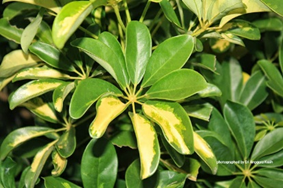
Tanaman walisongo mempunyai daun yang tumbuh berbentuk jari tangan pada batang utama. Daun tebal berwarna hijau mengkialap atau varigata. Bentuk daun ada yang bergelombang, ramping, lonjong, runcing atau menyerupai daun ubi kayu. Cirri khas tanaman walisongo yaitu jumlah daunnya yang banyak dan membentuk bulatan selayaknya tapak jari. Batang meliuk dan tidak lurus karena didukung oleh beberapa batang yang lain sehingga membentuk kombinasi perpaduan beberapa batang yang berbentuk rumpun.
Kandungan
| Golongan Senyawa | Kandungan Spesifik | Khasiat / Aktivitas Biologis |
| Flavonoid | quercetin, kaempferol, rutin | antioksidan, antiinflamasi, antimikroba |
| Saponin | saponin triterpenoid | menurunkan kolesterol, meningkatkan daya tahan tubuh |
| Tanin | tanin polifenolik | antibakteri, antiradang, penyembuhan luka |
| Steroid dan triterpenoid | β-sitosterol, lupeol | antiinflamasi, antikanker |
| Alkaloid | belum banyak diidentifikasi, namun ada jejak alkaloid | analgesik ringan, antimikroba |
| Minyak atsiri (volatile compounds) | seskuiterpen, aldehida aromatic | memberikan aroma khas dan efek antiseptik alami |
Khasiat
Meningkatkan stamina, menetralisir racun atau polusi udara, hingga mengatasi luka bakar.
Cara Pengolahan
- Pencucian: Daun dicuci bersih dengan air mengalir.
- Pengeringan: Jemur di tempat teduh (tidak langsung matahari) agar tidak merusak senyawa aktif.
- Penghalusan: Daun kering dapat ditumbuk atau diblender menjadi serbuk halus.
- Penyimpanan: Simpan serbuk dalam wadah kedap udara dan kering.
Contoh pemakaian:
-Luka luar / bisul: Tumbuk daun segar, tempelkan pada bagian yang luka.
-Batuk / flu ringan: Rebus 3–5 lembar daun dalam 2 gelas air hingga tersisa 1 gelas, minum setelah hangat.
DAFTAR PUSTAKA
Backer CA and Bakhuinzen van den Brink, 1968. Flora ofJava (Spermathophytes Beberapa Perguruan Tinggi di Indonesia X). Puslitbang Farmasi. Departemen Kesehatan RI.
Lin TS dan Yin HW, 1995. Effect of Litsea cubeba press oils on the control of Materia Medika Indonesia, vol. 2, 1978. Departemen Kesehatan RI, Jakarta.
Mayun, Ida Ayu. 2015. Indentifikasi Tanaman Lanskap pada Kampus Universitas Udayana Jalan Sudirman Denpasar. Denpasar : Udayana
Muslikhati, 1995. Penapisan Aktivitas Minyak Atsiri Tiga Jenis Tanaman only). Vol II!. Wolters-Noordhoff NV-Groningen, The Netherlands. Suku Lauraceae terhadap Mikroba. Dalam Penelitian Tanaman Obat di termite Coptotermes formosan us Shiraki. Taiwan For. Res. Inst. New Series. 10: 5963.
Vademekum Bahan Obat Alam. 1989. Departemen Kesehatan Rl, Jakarta.
.
.
WALI SONGO (Schefflera arboricola)
Latin Name
Schefflera arboricola.
Taksonomi
Kingdom : Plantae
Super divisi : Angiospermae
Divisi : Spermatophyta
Kelas : Dicotyledoneae
Ordo : Apiales
Famili : Araliaceae
(David G Frodin. (2010)
General Description
The walisongo plant has leaves that grow in a finger-like arrangement on the main stem. The leaves are thick and green, either glossy or variegated in appearance. The leaf shapes vary and may be wavy, narrow, oval, pointed, or resemble cassava leaves. A distinctive characteristic of the walisongo plant is the large number of leaves that form a circular pattern resembling the shape of a handprint. Its stems are curved and do not grow straight because they are supported by several other stems, creating a clustered combination of multiple stems that form a clump-like structure.
Contents
| Compound Group | Specific Compounds | Benefits / Biological Activities |
|---|---|---|
| Flavonoids | Quercetin, kaempferol, rutin | Antioxidant, anti-inflammatory, antimicrobial |
| Saponins | Triterpenoid saponins | Lower cholesterol levels and enhance the immune system |
| Tannins | Polyphenolic tannins | Antibacterial, anti-inflammatory, and promote wound healing |
| Steroids and Triterpenoids | β-sitosterol, lupeol | Anti-inflammatory and anticancer activities |
| Alkaloids | Not yet extensively identified, but traces of alkaloids have been detected | Mild analgesic and antimicrobial effects |
| Essential Oils (Volatile Compounds) | Sesquiterpenes, aromatic aldehydes | Provide a characteristic aroma and natural antiseptic effects |
Benefits
Increase stamina, neutralize toxins or air pollutants, and help treat burns.
Processing Methods
Washing: Wash the leaves thoroughly under running water.
Drying: Dry the leaves in a shaded area (away from direct sunlight) to prevent damage to the active compounds.
Grinding: The dried leaves can be pounded or blended into a fine powder.
Storage: Store the powder in a dry, airtight container.
Examples of Use:
- External wounds / boils: Crush fresh leaves and apply them to the affected area.
- Coughs / mild flu: Boil 3–5 leaves in 2 glasses of water until only 1 glass remains, then drink after it has cooled to a warm temperature.
References
Backer, C. A., & Bakhuizen van den Brink, R. C. (1968). Flora of Java (Spermatophytes Only), Volume III. Wolters-Noordhoff NV, Groningen, The Netherlands.
Department of Health of the Republic of Indonesia. (1978). Materia Medika Indonesia, Vol. 2. Jakarta: Department of Health of the Republic of Indonesia.
Lin, T. S., & Yin, H. W. (1995). Effect of Litsea cubeba Press Oils on the Control of Termite Coptotermes formosanus Shiraki. Taiwan Forestry Research Institute, New Series, 10, 59–63.
Mayun, I. A. (2015). Identification of Landscape Plants at Udayana University Campus, Sudirman Street, Denpasar. Denpasar: Udayana University.
Muslikhati. (1995). Screening the Activity of Essential Oils from Three Species of Lauraceae Plants Against Microorganisms. In Research on Medicinal Plants in Several Higher Education Institutions in Indonesia. Pharmaceutical Research and Development Center, Ministry of Health of the Republic of Indonesia.
Department of Health of the Republic of Indonesia. (1989). Vademecum of Natural Medicinal Materials. Jakarta: Department of Health of the Republic of Indonesia.