
Nama latin
Clitoria ternatea L.
Taksonomi
Kerajaan :Plantae
Sub kerajaan :Tracheobionta
Super Divisi :Spermatophyta
Divisi :Magnoliophyta
Kelas :Magnoliopsida
Sub kelas :Rosidae
Bangsa :Fabales
Keluarga :Fabaceae
Genus :Clitoria
Species :Clitoria ternatea L
(Hartono, 2018 dalam Handito, 2023)
Definisi umum
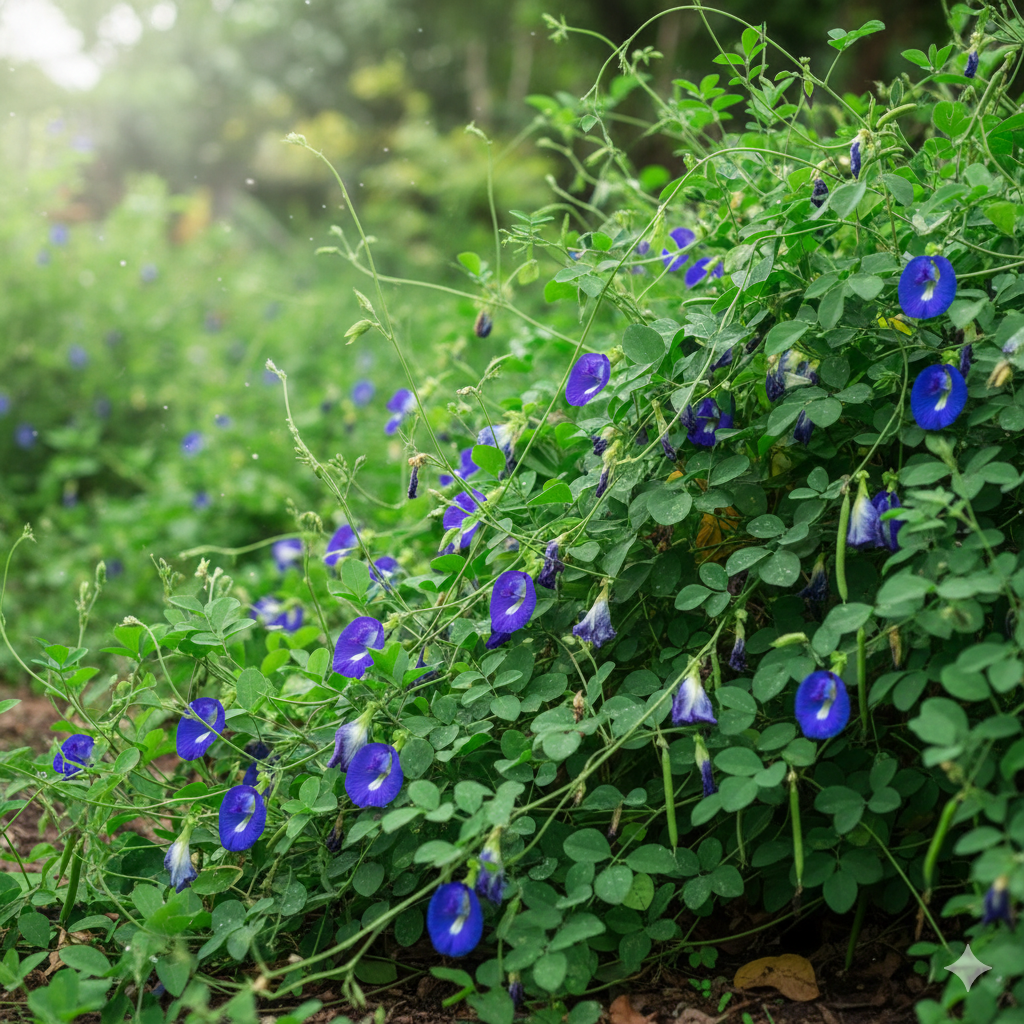
Clitoria ternatea L., yang dikenal sebagai bunga telang, merupakan tanaman herba tahunan dari famili Fabaceae yang tumbuh subur di daerah beriklim tropis serta menunjukkan ketahanan yang baik terhadap gangguan lingkungan (Yusuf et al., 2025). Tanaman ini menghasilkan bunga berbentuk kupu-kupu yang bersifat zigomorfik dan memiliki lima bagian (pentamerous), dengan kelopak berbentuk tabung yang terdiri atas lima sepal yang menyatu sekitar dua pertiga dari panjangnya (Oguis et al., 2019). Selain itu, bunga telang dikenal memiliki kandungan antioksidan yang tinggi dan umumnya tumbuh di pekarangan rumah, hutan, maupun pinggiran kebun (Sumartini et al., 2020). Tidak hanya itu, Clitoria ternatea L. juga banyak dimanfaatkan dalam pengobatan tradisional Ayurveda serta memiliki aplikasi luas di bidang kuliner (Ashraf et al., 2023; Maneechot et al., 2023). Kandungan bioaktif dalam ekstrak bunga telang meliputi senyawa flavonoid berupa antosianin, asam fenolat, flavon, flavonol glikosida, dan flavanol, serta berbagai senyawa terpenoid, alkaloid, dan peptida berupa siklotida (Marpaung, 2020).
Khasiat
Ekstrak bunga telang (Clitoria ternatea L.) diketahui memiliki berbagai potensi dan manfaat yang luas. Handito et al. (2022) menyatakan bahwa ekstrak bunga telang dapat dimanfaatkan sebagai pewarna alami lokal sekaligus sumber antioksidan alami yang dapat ditambahkan pada berbagai produk pangan. Sejalan dengan itu, Andriani dan Murtisiwi (2020) melaporkan bahwa ekstrak bunga telang memiliki aktivitas antioksidan yang sangat kuat, yaitu sebesar 41,36 μg/mL. Selain aktivitas antioksidan, Purba (2020) juga menyebutkan bahwa bunga telang memiliki potensi farmakologis lain seperti antimikroba, antidepresan, antelmintik, antikanker, dan antidiabetes. Selanjutnya, Pratiwi et al. (2020) menjelaskan bahwa aktivitas tanin pada ekstrak bunga telang dapat memberikan efek nefroprotektif terhadap paparan bahan toksik dengan cara mencegah peroksidasi lipid dan menekan pembentukan reactive oxygen species (ROS) yang dapat menyebabkan kematian sel. Selain itu, Ab Rashid et al. (2021) melaporkan bahwa mikrokapsul antosianin dari bunga telang juga memiliki aktivitas antibakteri. Hal ini didukung oleh Yurisna et al. (2022) yang menyebutkan bahwa kandungan flavonoid, antosianin, tanin, flavon, flavanol, asam fenolat, dan alkaloid dalam bunga telang berpotensi dimanfaatkan sebagai antibakteri pada produk pangan.
Cara pengolahan
Cara pengolahan bunga telang menjadi teh dilakukan melalui beberapa tahap. Bunga telang yang telah dipanen dicuci hingga bersih, kemudian dikeringkan di bawah sinar matahari atau menggunakan oven pada suhu 60°C hingga benar-benar kering. Setelah itu, bunga kering dihaluskan hingga menjadi serbuk simplisia, lalu dikemas dan disegel sebagai teh bunga telang (Widjajanti et al., 2023).
Herlina et al. (2023) menjelaskan bahwa pengolahan bunga telang dapat dilakukan menjadi berbagai bentuk minuman seperti sirup, teh, dan air seduhan yang dapat langsung dikonsumsi. Proses penyeduhan pada suhu tertentu berpengaruh terhadap kandungan antosianin yang berperan sebagai antioksidan dalam minuman tersebut.
Sementara itu, ekstrak bunga telang juga dapat dicampurkan dengan berbagai bahan pangan lainnya. Ekstrak ini memiliki ketahanan terhadap proses pemanasan seperti pasteurisasi, sehingga berpotensi digunakan sebagai pewarna alami sekaligus penambah aktivitas antioksidan dalam produk pangan (Kurniadi et al., 2024).
Referensi
Ab Rashid, S., Tong, W. Y., Leong, C. R., Abdul Ghazali, N. M., Taher, M. A., Ahmad, N., … Teo, S. H. (2021). Anthocyanin Microcapsule from Clitoria ternatea: Potential Bio-preservative and Blue Colorant for Baked Food Products. Arabian Journal for Science and Engineering, 46(1), 65–72. https://doi.org/10.1007/s13369-020-04716-y
Andriani, D., & Murtisiwi, L. (2020). Uji aktivitas antioksidan ekstrak etanol 70 % bunga telang (Clitoria ternatea L.) dari daerah Sleman dengan metode DPPH. Pharmacon: Jurnal Farmasi Indonesia, 17(1), 70–76. https://doi.org/10.23917/pharmacon.v17i1.9321
Ashraf, K., Adlin, N. F., Basri, A. N., Ahmad, W., & Sultan, S. (2023). The traditional uses, phytochemistry, and pharmacological effects of Clitoria ternatea: A review. Indian Journal of Pharmaceutical Education and Research, 58(1), 1–14. https://doi.org/10.5530/ijper.58.1.1
Handito, D., Basuki, E., Saloko, S., Dwikasari, L. G., & Triani, E. (2022). Analisis komposisi bunga telang (Clitoria ternatea) sebagai antioksidan alami pada produk pangan. Prosiding SAINTEK, 4, 64-70. LPPM Universitas Mataram. E-ISSN: 2774-8057. https://eprints.unram.ac.id/40868/1/B50.pdf
Handito, R., & Pratiwi, N. (2023). Klasifikasi dan potensi bunga telang (Clitoria ternatea L.) sebagai tanaman obat. Jurnal Biologi Tropika, 10(2), 45–52.
Herlina, H., Jannah, S., Mulyani, E., & Sembiring, M. (2023). Analisa antosianin pada minuman olahan bunga telang (Clitoria ternatea L.) dengan metode pH differensial. Parapemikir: Jurnal Ilmiah Farmasi, 12(2), 1–10. p-ISSN 2089-5313 | e-ISSN 2549-5062. Retrieved from https://ejournal.poltekharber.ac.id/index.php/parapemikir/article/download/5138/pdf_135
Kurniadi, A., Sartika, D., Herdiana, N., & Susilawati. (2024). Kajian formulasi ekstrak bunga telang (Clitoria ternatea) terhadap aktivitas antioksidan pada minuman fungsional. Jurnal Agroindustri
Maneechot, O., Hahor, W., Thongprajukaew, K., Nuntapong, N., & Bubaka, S. (2023). A natural blue colorant from butterfly pea (Clitoria ternatea) petals for traditional rice cooking. Journal of Food Science and Technology, 60(8), 2255–2264. https://doi.org/10.1007/s13197-023-05752-w
Marpaung, A. M. (2020). Tinjauan manfaat bunga telang (Clitoria ternatea L.) bagi kesehatan manusia. Journal of Functional Food and Nutraceutical, 1(2), 63–85. https://doi.org/10.33555/jffn.v1i2.30
Oguis, G. K., Gilding, E. K., Jackson, M. A., & Craik, D. J. (2019). Butterfly Pea (Clitoria ternatea), a cyclotide-bearing plant with applications in agriculture and medicine. Frontiers in Plant Science, 10, 645. https://doi.org/10.3389/fpls.2019.00645
Pratiwi, E. R., Rahmandani, S. O. A., Ibrahim, A. R., & Isbandiyah, I. (2020). Potensi Ekstrak Bunga Telang (Clitoria ternatea) Sebagai Pencegah Acute Kidney Injury (AKI). CoMPHI Journal: Community Medicine and Public Health of Indonesia Journal, 1(2), 92–100. https://doi.org/10.37148/comphijournal.v1i2.16
Purba, E. C. (2020). Kembang telang (Clitoria ternatea L.): Pemanfaatan dan bioaktivitas. EduMatSains, 4(2), 111–124. https://ojs.mahadewa.ac.id/index.php/santimas/article/download/3244/2231/11942?utm_source=chatgpt.com
Sumartini, Y., Ikrawan, Y., & Muntaha, F. M. (2020). Analisis bunga telang (Clitoria ternatea) dengan variasi pH metode Liquid Chromatograph-Tandem Mass Spectrometry (LC-MS/MS). Pasundan Food Technology Journal, 7(2), 70. Program Studi Teknologi Pangan, Fakultas Teknik, Universitas Pasundan. E-ISSN: 2615-1405. https://doi.org/10.23969/pftj.v7i2.2983
Yurisna, V. C., Nabila, F. S., Radhityaningtyas, D., & Listyaningrum, F. (2022). Potensi bunga telang (Clitoria ternatea L.) sebagai antibakteri pada produk pangan. JITIPARI (Jurnal Ilmiah Teknologi dan Industri Pangan UNISRI), 7(1), 68-77. https://doi.org/10.33061/jitipari.v7i1.5738
Yusuf, A. F., Latifah, V. R., Nurcahyati, V. I., Nurhasanah, A. D., Widyasari, A. S., Nainggolan, A. P., Hasibuan, A. R. W., Hidayat, M. A., Karmilah, Pratiwi, A. D., Aurantika, R., Hasanah, M., Aristya, G. R., Arisuryanti, T., Handayani, N. S. N., Lesmana, I., & Daryono, B. S. (2025). Intra-specific diversity of butterfly pea (Clitoria ternatea L.) revealed by ISSR with invariable ITS records. BIOTROPIA: The Southeast Asian Journal of Tropical Biology, 32(1), 57–68. https://doi.org/10.11598/btb.2025.32.1.2362
Widjajanti, H., Aminasih, N., Muharni, & Arwinsyah. (2023). Pengolahan bunga telang (Clitoria ternatea L.) sebagai minuman kaya antioksidan dan pewarna alami makanan. Jurnal Altifani: Penelitian dan Pengabdian kepada Masyarakat, 3(3), 423–431. https://doi.org/10.59395/altifani.v3i3.399
Bunga Telang (Clitoria ternatea L.)
Latin name
Clitoria ternatea L.
Taxonomy
Kingdom :Plantae
Subkingdom :Tracheobionta
Superdivision :Spermatophyta
Division :Magnoliophyta
Class :Magnoliopsida
Subclass :Rosidae
Order: Fabales
Family: Fabaceae
Genus: Clitoria
Species: Clitoria ternatea L.
(Hartono, 2018 in Handito, 2023)
General Definition
Clitoria ternatea L., commonly known as the butterfly pea flower, is an annual herbaceous plant of the Fabaceae family that thrives in tropical climates and exhibits good resilience to environmental stress (Yusuf et al., 2025). This plant produces butterfly-shaped flowers that are zygomorphic and pentamerous, with a tubular calyx consisting of five fused sepals extending about two-thirds of its length (Oguis et al., 2019). Additionally, the butterfly pea is known for its high antioxidant content and is commonly found in home gardens, forests, and garden edges (Sumartini et al., 2020). Not only that, Clitoria ternatea L. is also widely used in traditional Ayurvedic medicine and has extensive applications in the culinary field (Ashraf et al., 2023; Maneechot et al., 2023). The bioactive compounds in butterfly pea flower extract include flavonoids such as anthocyanins, phenolic acids, flavones, flavonol glycosides, and flavanols, as well as various terpenoids, alkaloids, and cyclotides (Marpaung, 2020).
Benefits
Butterfly pea flower extract (Clitoria ternatea L.) is known to possess a wide range of potential applications and benefits. Handito et al. (2022) state that butterfly pea flower extract can be utilized as a local natural dye as well as a source of natural antioxidants that can be added to various food products. In line with this, Andriani and Murtisiwi (2020) reported that butterfly pea flower extract exhibits very strong antioxidant activity, amounting to 41.36 μg/mL. In addition to antioxidant activity, Purba (2020) also noted that the butterfly pea flower possesses other pharmacological potentials, such as antimicrobial, antidepressant, anthelmintic, anticancer, and antidiabetic properties. Furthermore, Pratiwi et al. (2020) explain that the tannin activity in butterfly pea flower extract can provide a nephroprotective effect against exposure to toxic substances by preventing lipid peroxidation and suppressing the formation of reactive oxygen species (ROS), which can cause cell death. Additionally, Ab Rashid et al. (2021) reported that anthocyanin microcapsules derived from butterfly pea flowers also exhibit antibacterial activity. This is supported by Yurisna et al. (2022) who stated that the content of flavonoids, anthocyanins, tannins, flavonols, flavanols, phenolic acids, and alkaloids in butterfly pea flowers has the potential to be used as an antibacterial in food products.
Processing Method
The method of processing butterfly pea flowers into tea is carried out in several stages. The harvested butterfly pea flowers are washed until clean, then dried under sunlight or using an oven at 60°C until completely dry. After that, the dried flowers are ground into a simplicia powder, then packaged and sealed as butterfly pea flower tea (Widjajanti et al., 2023).
Herlina et al. (2023) explained that the processing of butterfly pea flowers can be done into various forms of beverages such as syrup, tea, and infusion that can be consumed directly. The brewing process at a certain temperature affects the anthocyanin content, which acts as an antioxidant in the beverage.
Meanwhile, butterfly pea flower extract can also be mixed with various other food ingredients. This extract has resistance to heating processes such as pasteurization, making it potentially useful as a natural colorant as well as an enhancer of antioxidant activity in food products (Kurniadi et al., 2024).
References
Ab Rashid, S., Tong, W. Y., Leong, C. R., Abdul Ghazali, N. M., Taher, M. A., Ahmad, N., … Teo, S. H. (2021). Anthocyanin Microcapsule from Clitoria ternatea: Potential Bio-preservative and Blue Colorant for Baked Food Products. Arabian Journal for Science and Engineering, 46(1), 65–72. https://doi.org/10.1007/s13369-020-04716-y
Andriani, D., & Murtisiwi, L. (2020). Antioxidant activity test of 70% ethanol extract of butterfly pea flowers (Clitoria ternatea L.) from Sleman region using the DPPH method. Pharmacon: Journal of Indonesian Pharmacy, 17(1), 70–76. https://doi.org/10.23917/pharmacon.v17i1.9321
Ashraf, K., Adlin, N. F., Basri, A. N., Ahmad, W., & Sultan, S. (2023). The traditional uses, phytochemistry, and pharmacological effects of Clitoria ternatea: A review. Indian Journal of Pharmaceutical Education and Research, 58(1), 1–14. https://doi.org/10.5530/ijper.58.1.1
Handito, D., Basuki, E., Saloko, S., Dwikasari, L. G., & Triani, E. (2022). Analysis of the composition of butterfly pea flowers (Clitoria ternatea) as a natural antioxidant in food products. SAINTEK Proceedings, 4, 64-70. LPPM Universitas Mataram. E-ISSN: 2774-8057. https://eprints.unram.ac.id/40868/1/B50.pdf
Handito, R., & Pratiwi, N. (2023). Classification and potential of butterfly pea flowers (Clitoria ternatea L.) as medicinal plants. Tropical Biology Journal, 10(2), 45–52.
Herlina, H., Jannah, S., Mulyani, E., & Sembiring, M. (2023). Analysis of anthocyanins in drinks processed from butterfly pea flowers (Clitoria ternatea L.) using the differential pH method. Parapemikir: Journal of Pharmaceutical Science, 12(2), 1–10. p-ISSN 2089-5313 | e-ISSN 2549-5062. Retrieved from https://ejournal.poltekharber.ac.id/index.php/parapemikir/article/download/5138/pdf_135
Kurniadi, A., Sartika, D., Herdiana, N., & Susilawati. (2024). Study on the formulation of butterfly pea flower extract (Clitoria ternatea) on antioxidant activity in functional drinks. Journal of Agroindustry
Maneechot, O., Hahor, W., Thongprajukaew, K., Nuntapong, N., & Bubaka, S. (2023). A natural blue colorant from butterfly pea (Clitoria ternatea) petals for traditional rice cooking. Journal of Food Science and Technology, 60(8), 2255–2264. https://doi.org/10.1007/s13197-023-05752-w
Marpaung, A. M. (2020). Review of the benefits of butterfly pea flower (Clitoria ternatea L.) for human health. Journal of Functional Food and Nutraceutical, 1(2), 63–85. https://doi.org/10.33555/jffn.v1i2.30
Oguis, G. K., Gilding, E. K., Jackson, M. A., & Craik, D. J. (2019). Butterfly Pea (Clitoria ternatea), a cyclotide-bearing plant with applications in agriculture and medicine. Frontiers in Plant Science, 10, 645. https://doi.org/10.3389/fpls.2019.00645
Pratiwi, E. R., Rahmandani, S. O. A., Ibrahim, A. R., & Isbandiyah, I. (2020). The Potential of Butterfly Pea Flower (Clitoria ternatea) Extract as a Preventive for Acute Kidney Injury (AKI). CoMPHI Journal: Community Medicine and Public Health of Indonesia Journal, 1(2), 92–100. https://doi.org/10.37148/comphijournal.v1i2.16
Purba, E. C. (2020). Butterfly pea (Clitoria ternatea L.): Utilization and bioactivity. EduMatSains, 4(2), 111–124. https://ojs.mahadewa.ac.id/index.php/santimas/article/download/3244/2231/11942?utm_source=chatgpt.com
Sumartini, Y., Ikrawan, Y., & Muntaha, F. M. (2020). Analysis of butterfly pea flowers (Clitoria ternatea) with pH variation using the Liquid Chromatograph-Tandem Mass Spectrometry (LC-MS/MS) method. Pasundan Food Technology Journal, 7(2), 70. Food Technology Study Program, Faculty of Engineering, Universitas Pasundan. E-ISSN: 2615-1405. https://doi.org/10.23969/pftj.v7i2.2983
Yurisna, V. C., Nabila, F. S., Radhityaningtyas, D., & Listyaningrum, F. (2022). Potential of butterfly pea flowers (Clitoria ternatea L.) as antibacterial agents in food products. JITIPARI (Scientific Journal of Food Technology and Industry UNISRI), 7(1), 68-77. https://doi.org/10.33061/jitipari.v7i1.5738
Yusuf, A. F., Latifah, V. R., Nurcahyati, V. I., Nurhasanah, A. D., Widyasari, A. S., Nainggolan, A. P., Hasibuan, A. R. W., Hidayat, M. A., Karmilah, Pratiwi, A. D., Aurantika, R., Hasanah, M., Aristya, G. R., Arisuryanti, T., Handayani, N. S. N., Lesmana, I., & Daryono, B. S. (2025). Intra-specific diversity of butterfly pea (Clitoria ternatea L.) revealed by ISSR with invariable ITS records. BIOTROPIA: The Southeast Asian Journal of Tropical Biology, 32(1), 57–68. https://doi.org/10.11598/btb.2025.32.1.2362 Widjajanti, H., Aminasih, N., Muharni, & Arwinsyah. (2023). Processing butterfly pea flowers (Clitoria ternatea L.) as a beverage rich in antioxidants and natural food coloring. Jurnal Altifani: Research and Community Service, 3(3), 423–431. https://doi.org/10.59395/altifani.v3i3.399