
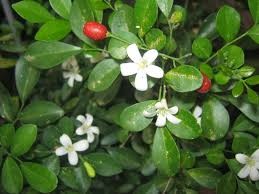
Nama Latin
Eugenia uniflora L
Taksonomi
Kingdom: Plantae
Divisi: Spermatophyta
Sub Divisi: Angiospermae
Ordo: Myrtales
Famili: Myrtaceae
Genus: Eugenia
Spesies: Eugenia uniflora (Sinaga ,2025)
Definisi Umum
Dewandaru merupakan salah satu jenis koleksi tumbuhan di Kebun Raya Purwodadi Tumbuhan yang termasuk dalam suku jambu-jambuan (Myrtaceae) dengan nama ilmiah Eugenia uniflora L. Mengutip data The Plant List (2013), tumbuhan ini memiliki 46 nama sinonim. Berdasarkan Verheij & Coronel (1992), habitus tumbuhan ini berupa semak atau pohon dengan ketinggian mencapai 7 meter. Cabang menyebar, ramping, dan terkadang melekuk. Permukaan batang halus dan kulit batang mengelupas. Daun tunggal berbentuk bulat telur sungsang, bagian pangkal membulat atau sedikit terbilah, ujung meruncing dan tumpul, permukaan halus, mengkilat. Warna daun cokelat kemerahan saat masih muda dan berubah menjadi hijau gelap ketika tua. Saat musim dingin atau kering, daun akan berwarna merah. Bunga wangi, terdiri atas 1-4 bunga yang menyatu di ketiak daun, berwarna putih krem, dan berdiameter sekitar 1 cm. Kelopak bunga berbentuk tabung dengan 8 rusuk dan 4 lekukan. Mahkota bunga berwarna putih dan panjang 7-11 mm. Jumlah benang sari sekitar 50-60 helai. Buah menggantung, berbentuk bulat pipih dan terdapat 7-8 rusuk seperti lampion. Buah berwarna hijau saat masih muda dan akan berubah menjadi oranye, hingga merah terang atau gelap keunguan. Kulit buah tipis, daging buah oranye hingga merah, berair dan sedikit lengket, rasa masam hingga manis. Biji berbentuk pipih dan umumnya berjumlah 1 butir dengan ukuran besar atau 2-3 butir dengan ukuran kecil.
Kandungan
Ogunwande et al. (2005) dan Amorim et al. (2009) menjelaskan bahwa ekstrak hidroalkoholik daun dewandaru dapat mengurangi kadar enzim xanthine-oxidase yang memicu terbentuknya asam urat. Santos et al. (2015) menyebutkan bahwa ekstrak daun E. uniflora mengandung minyak esensial yang terdiri atas atractylone (16,90%), curzerene (19,70%), selina-1,3,7-trien-8-one (17,80%), dan furanodiene (9,60%). Pada ekstrak daun yang masih muda terkandung senyawa sesquiterpene jenis germacrone sebesar 35,59%. Beberapa penelitian lain menyebutkan bahwa dewandaru juga memiliki kemampuan antimikroba. Sobeh et al. (2016) telah melakukan penelitian tentang kemampuan antimikroba ekstrak minyak esensial dewandaru. Hasil penelitian tersebut menunjukkan adanya daya hambat terhadap pertumbuhan bakteri gram positif seperti Staphylococcus aureus, S. epidermidis, Bacillus licheniformis, B. subtilis, Enterococcus faecalis, dan bakteri gram negatif seperti Escherichia coli, Klebsiella pneumoniae, Pseudomonas aeruginosa, serta fungi Candida parapsilosis dan C. albicans. Buah dewandaru juga kaya akan antioksidan. Berdasarkan hasil analisa Bagetti et al. (2011), antioksidan tertinggi terdapat pada buah dewandaru yang masih berwarna oranye karena kaya akan karotenoid. Di samping itu, biji dewandarujuga kaya antioksidan karena kandungan senyawa fenolik yang sangat tinggi (Luzia et al., 2010).
Khasiat
- diare
- demam
- hipertensi
- rematik
- cacingan
- bronkitis
- batuk.
Hasil observasi Ogunwande et al. (2005) dan Amorim et al. (2009)
Cara Pengolahan
Daun dicuci, dikeringkan pada suhu ruang, dan digiling dengan mixer. Rebusan air panas: 10 g sampel bubuk dilarutkan dalam 100 ml air suling, dididihkan selama satu setengah jam, lalu disaring. Rebusan disimpan pada suhu 4°C untuk penggunaan selanjutnya.
Daftar Pustaka
Daniel, G., & Kumari, S. K. (2019). Free radical scavenging activity of aqueous (hot) extract of Eugenia uniflora (L.) leaves. Journal of Plant Biochemistry & Physiology, 7(1), 1–4.
Rencana, E. (2020). Dewandaru (Eugenia uniflora L.). Warta Kebun Raya, 18(1), 1–10.
(PDF) Dewandaru (Eugenia uniflora L.), Buah Legendaris yang Sarat Mitologi di Pegunungan Kawi https://share.google/YkEGx7MTY3X8uKXAh
Sinaga, 2025. Identifikasi Tumbuhan Famili Myrtaceae di Kawasan Jalan Sukarela Timur, Desa Lau Dendang, Kecamatan Percut Sei Tuan. Alacrity : Jurnal Of education https://doi.org/10.52121/alacrity.v5i1.539
Dewandaru (Eugenia uniflora L.)
Latin Name

Eugenia uniflora L.

Taxonomy

Kingdom: Plantae

Division: Spermatophyta

Subdivision: Angiospermae

Order: Myrtales

Family: Myrtaceae

Genus: Eugenia

Species: Eugenia uniflora (Sinaga, 2025)
General Definition

Dewandaru is one of the plant collections at the Purwodadi Botanical Gardens. It belongs to the guava family (Myrtaceae) and has the scientific name Eugenia uniflora L. According to The Plant List (2013), this plant has 46 synonyms. According to Verheij & Coronel (1992), this plant has a shrub or tree habit, reaching a height of 7 meters. The branches are spreading, slender, and sometimes curved. The stem surface is smooth, and the bark peels. The single leaves are obovate, with a rounded or slightly lobed base, a pointed and blunt tip, and a smooth, shiny surface. The leaves are reddish-brown when young and turn dark green as they mature. During winter or dry seasons, the leaves turn red. The fragrant flowers, consisting of 1-4 flowers fused in the leaf axils, are creamy white, and approximately 1 cm in diameter. The calyx is tubular with 8 ribs and 4 grooves. The corolla is white and 7-11 mm long. The stamens number around 50-60. The fruit is hanging, round and flat, with 7-8 ribs like a lantern. The fruit is green when young and eventually changes to orange, then bright red or dark purple. The skin is thin, and the flesh is orange to red, juicy and slightly sticky, with a sour to sweet taste. The seeds are flat and generally number one large seed or two or three small seeds.
Content

Ogunwande et al. (2005) and Amorim et al. (2009) explained that hydroalcoholic extract of dewandaru leaves can reduce levels of the xanthine oxidase enzyme, which triggers uric acid formation. Santos et al. (2015) stated that E. uniflora leaf extract contains essential oils consisting of atractylone (16.90%), curzerene (19.70%), selina-1,3,7-triene-8-one (17.80%), and furanodiene (9.60%). Young leaf extract contains 35.59% of the sesquiterpene compound germacrone. Several other studies have shown that dewandaru also has antimicrobial properties. Sobeh et al. (2016) conducted research on the antimicrobial properties of dewandaru essential oil extract. The results of the study showed that there was an inhibitory effect on the growth of gram-positive bacteria such as Staphylococcus aureus, S. epidermidis, Bacillus licheniformis, B. subtilis, Enterococcus faecalis, and gram-negative bacteria such as Escherichia coli, Klebsiella pneumoniae, Pseudomonas aeruginosa, and fungi Candida parapsilosis and C. albicans. Dewandaru fruit is also rich in antioxidants. Based on the analysis results of Bagetti et al. (2011), the highest antioxidants are found in dewandaru fruit that is still orange because it is rich in carotenoids. In addition, dewandaru seeds are also rich in antioxidants because they contain very high phenolic compounds (Luzia et al., 2010).
Benefits

1. diarrhea
2. fever
3. hypertension
4. rheumatism
5. worm infestation
6. bronchitis
7. cough.

Observations by Ogunwande et al. (2005) and Amorim et al. (2009)

Processing Method

The leaves are washed, dried at room temperature, and ground with a mixer. Hot water decoction: 10 g of the powdered sample is dissolved in 100 ml of distilled water, boiled for one and a half hours, then filtered. The decoction is stored at 4°C for later use.
Bibliography

Daniel, G., & Kumari, S. K. (2019). Free radical scavenging activity of aqueous (hot) extract of Eugenia uniflora (L.) leaves. Journal of Plant Biochemistry & Physiology, 7(1), 1–4.

Plan, E. (2020). Dewandaru (Eugenia uniflora L.). Warta Kebun Raya, 18(1), 1–10.
(PDF) Dewandaru (Eugenia uniflora L.), a Legendary Fruit Steeped in Mythology in the Kawi Mountains https://share.google/YkEGx7MTY3X8uKXAh

Sinaga, 2025. Identification of Plants of the Myrtaceae Family in the Jalan Sukarela Timur Area, Lau Dendang Village, Percut Sei Tuan District. Alacrity : Journal Of education  https://doi.org/10.52121/alacrity.v5i1.539