
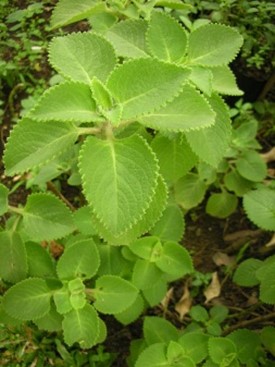
Nama Tumbuhan
Daun Jinten (Coleus Aromaticus Benth)
Taksonomi Tumbuhan
Kingdom : Plantae
Divisi : Magnoliophyta
Kelas : Magnoliopsida
Ordo : Lamiales
Famili : Lamiaceae
Genus : Coleus
Spesies : Coleus Aromaticus Benth
(Safithri, 2017)
Definisi Umum
Daun jinten merupakan tanaman yang sering dipergunakan sebagai bumbu masakan yang berasal dari benua Afrika dan dimanfaatkan sebagai bahan makanan pada berbagai negara seperti Asia,Afrika dan Amerika (Wadikar dan Patki, 2016). Daun jinten memiliki nama lain yaitu daun bangun-bangun atau torbangun, Oregano, Five season herb, Broad-leaf thyme, Patharchur, dan Indian borage (Rahmawati et al., 2021). Tanaman daun jinten memiliki ciri dengan daun berselang seling, tepi daun bergerigi, daun berbulu dan berwarna hijau (Nasution, 2017). Selain itu, batangnya bulat, berdaging dan berambut, berwarna hijau hingga merah muda, dan memiliki karakter aromatis. Akarnya berwarna coklat dan memiliki aroma. Bunganya berwarna ungu, dengan panjang 3-4 mm, bertangkai pendek, dalam rumpun panjang ramping yang tegak (Hullatti & Bhattacharjee, 2011).
Kandungan
Daun jinten mengandung senyawa penting atau metabolit sekunder seperti flavonoid, fenol, alkaloid, tanin, steroid dan saponin (Sujamol et al., 2020). Tanaman ini terkenal akan rasa dan aroma mirip dengan oregano yang khas, menunjukkan variasi kandungan senyawa volatilnya seperti karvakrol, thymol, terpinen dan caryophyllene (Verma et al., 2012).
Khasiat
Daun jinten memiliki aktivitas biokimia sebagai memiliki kemampuan untuk menghambat reaksi oksidasi dengan mengikat molekul yang sangat reaktif dan radikal bebas. (Silalahi dan Astuti, 2023). Daun jinten juga memiliki aktifitas biokimia lainnya seperti antimikrobial, antifungal, antiinflamasi, antibakterial, antidiabetes, antidiuretik, anxiolytic activity, antineoplastic, penyembuhan luka, penyakit pernapasan, antiurolithiatic, analgesik, artritis reumatoid, dan antiplatelet aggregation activity (Kumar et al., 2020). Khasiat daun jinten diantaranya juga dapat untuk mengobati batuk, infeksi tenggorokan, dan hidung tersumbat (Ramadahan, 2016). Selain itu, daun jinten juga dapat untuk memperlancar asi pada ibu menyusui (Oktiningrum dan Harjanti, 2023).
Cara Pengolahan
Pengolahan daun jinten secara tradisional dapat menggunakan beberapa cara, yaitu rebusan daun jinten sebagai teh dan kompres daun jinten. Perebusan daun jinten diawali mencuci daun segar, lalu direbus dan diminum hangat, atau dapat juga ditambahkan dengan madu (Satheesh et al., 2022). Kompres daun jinten yaitu dengan menumbuk daun jinten hingga menjadi pasta, lalu tempelkan pada kulit yang luka (Filipe et al., 2025). Selain itu, daun jinten juga dapat diolah sebagai simplisia daun jinten dengan daun dikeringkan, atau dapat juga sebagai lalapan atau bumbu masakan.
Daftar Pustaka
Filipe, M.S., Bangay, G., Brauning, F. Z., Ogungbemiro, F. O., Palma, B. B., Díaz-Lanza, A. M., … & Rijo, P. (2025). Plectranthus amboinicus: A Systematic Review of Traditional Uses, Phytochemical Properties, and Therapeutic Applications. Pharmaceuticals, 18(5), 707. https://doi.org/10.3390/ph18050707.
Hullatti, K.K. and Bhattacharjee, P. (2011). Pharmacognostical evaluation of different parts of Coleus amboinicus lour., Lamiaceae. Pharmacognosy Journal, 3(24): 39–44. https://doi.org/10.5530/pj.2011.24.8.
Kumar, P., Sangam, Kumar, N. (2020). Plectranthus amboinicus: a review on its pharmacological and, pharmacognostical studies. American journal of physiology, biochemistry and pharmacology, 10(2), 55–62. https://www.ajpbp.com/abstract/plectranthus-amboinicus-a-review-on-its-pharmacological-and-pharmacognosticalc-studies-48022.html.
Nasution. N, Luthfi A. M. Siregar, E. S. Bayu. (2017). Karakteristik Pertumbuhan Vegetatif dari Beberapa Aksesi Tanaman Bangun-Bangun (Plectranthus amboinicus (Lour.) Spreng). Jurnal Agroekoteknologi, 5(1): 26-32. https://doi.org/10.32734/ja.v5i1.2286.
Oktiningrum, M., & Harjanti, A. I. (2023). Literatur Review: Pemanfaatan Bahan Alam Guna Memperlancar ASI pada Ibu Menyusui. In Prosiding Seminar Nasional dan CFP Kebidanan Universitas Ngudi Waluyo. 2(1), 138-146. https://callforpaper.unw.ac.id/index.php/semnasdancfpbidanunw/article/view/442.
Rahmawati, R., Astuti, P., & Wahyuono, S. (2021). Profil Fitokimia dan Multipotensi dari Coleus amboinicus (Lour.). JPSCR: Journal of Pharmaceutical Science and Clinical Research, 6(2), 158-188. https://doi.org/10.20961/jpscr.v6i2.47436.
Ramadhan, G. C. (2016). Uji daya analgetik ekstrak etanol daun jinten (Coleus amboinicus L.) pada mencit dengan metode rangsang kimia. Indonesian Journal on Medical Science, 3(2), 31-37. https://download.garuda.kemdikbud.go.id/article.php?article=2926772&val=25832&title=UJI%20DAYA%20ANALGETIK%20EKSTRAK%20ETANOL%20DAUN%20JINTEN%20Coleus%20amboinicus%20L%20PADA%20MENCIT%20DENGAN%20METODE%20RANGSANG%20KIMIA.
Satheesh, V., Kaur, J., Jarial, S., Ghosh, P., Sharma, K., Patni, M., … & Bhadariya, V. (2022). Indian borage: A comprehensive review on the nutritional profile and diverse pharmacological significance. The Pharma Innovation Journal, 11(6), 42-51. https://www.thepharmajournal.com/archives/?year=2022&vol=11&issue=6&ArticleId=13535.
Silalahi, M. (2018). Plectranthus amboinicus (lour.) Spreng sebagai bahan pangan dan obat serta bioaktivitasnya. Jurnal Dinamika Pendidikan, 11(2), 123-138. http://repository.uki.ac.id/id/eprint/452.
Sujamol, M. S., Roy, J., & James, K. M. (2021). Phytochemical screening and antimicrobial activity of Coleus aromaticus leaf extract. Materials Today: Proceedings, 41, 596-599. https://doi.org/10.1016/j.matpr.2020.05.255.
Verma, R.S, Padalia, R.C.,and Chauhan, A. (2012). Essential oil composition of coleus aromaticus benth. from uttarakhand. Journal of Essential Oil-Bearing Plants, 15(2): 174–179. https://doi.org/10.1080/0972060X.2012.10644033.
Wadikar, D.D., and Patki, P.E. (2016). Coleus aromaticus: a therapeutic herb with multiple potentials. J Food Sci Technol. 53(7): 2895-2901. https://doi.org/10.1007/s13197-016-2292-y.
Cumin Leaves (Coleus Aromaticus Benth)
Coriander Leaves (Coleus Aromaticus Benth)
Plant Taxonomy
Kingdom: Plantae
Division: Magnoliophyta
Class: Magnoliopsida
Order: Lamiales
Family: Lamiaceae
Genus: Coleus
Species: Coleus Aromaticus Benth
(Safithri, 2017)
General Definition
Cumin leaves are a plant commonly used as a culinary spice that originates from the African continent and is utilized as a food ingredient in various countries across Asia, Africa, and the Americas (Wadikar and Patki, 2016). Oregano is also known by other names, including bangun-bangun or torbangun, Oregano, Five season herb, Broad-leaf thyme, Patharchur, and Indian borage (Rahmawati et al., 2021). The oregano plant is characterized by alternate leaves, serrated leaf margins, hairy leaves, and a green color (Nasution, 2017). Additionally, the stem is round, fleshy, and hairy, ranging in color from green to pink, and possesses an aromatic quality. The roots are brown and aromatic. The flowers are purple, 3–4 mm long, with short stalks, arranged in slender, upright clusters (Hullatti & Bhattacharjee, 2011).
Composition
Cumin leaves contain important compounds or secondary metabolites such as flavonoids, phenols, alkaloids, tannins, steroids, and saponins (Sujamol et al., 2020). This plant is known for its distinctive flavor and aroma, similar to oregano, indicating variations in its volatile compound content, such as carvacrol, thymol, terpinene, and caryophyllene (Verma et al., 2012).
Benefits
Cumin leaves possess biochemical activity, specifically the ability to inhibit oxidative reactions by binding to highly reactive molecules and free radicals (Silalahi and Astuti, 2023). Cumin leaves also possess other biochemical activities, including antimicrobial, antifungal, anti-inflammatory, antibacterial, antidiabetic, antidiuretic, anxiolytic, antineoplastic, wound-healing, respiratory disease-relieving, antiurolithiatic, analgesic, rheumatoid arthritis-relieving, and antiplatelet aggregation activities (Kumar et al., 2020). The benefits of fennel leaves also include treating coughs, throat infections, and nasal congestion (Ramadahan, 2016). Additionally, fennel leaves can help increase breast milk production in breastfeeding mothers (Oktiningrum and Harjanti, 2023).
Methods of Preparation
Traditionally, cumin leaves can be prepared in several ways, including brewing them as tea and using them as a compress. To prepare the tea, start by washing the fresh leaves, then boil them and drink the tea while it is still warm; honey may also be added (Satheesh et al., 2022). To make a cumin leaf compress, pound the leaves into a paste and apply it to the affected skin (Filipe et al., 2025). Additionally, cumin leaves can be processed into dried leaf preparations, or used as a fresh side dish or cooking spice.
References
Filipe, M.S., Bangay, G., Brauning, F. Z., Ogungbemiro, F. O., Palma, B. B., Díaz-Lanza, A. M., … & Rijo, P. (2025). Plectranthus amboinicus: A Systematic Review of Traditional Uses, Phytochemical Properties, and Therapeutic Applications. Pharmaceuticals, 18(5), 707. https://doi.org/10.3390/ph18050707.
Hullatti, K.K. and Bhattacharjee, P. (2011). Pharmacognostical evaluation of different parts of Coleus amboinicus Lour., Lamiaceae. Pharmacognosy Journal, 3(24): 39–44. https://doi.org/10.5530/pj.2011.24.8.
Kumar, P., Sangam, Kumar, N. (2020). Plectranthus amboinicus: a review on its pharmacological and pharmacognostical studies. American Journal of Physiology, Biochemistry and Pharmacology, 10(2), 55–62. https://www.ajpbp.com/abstract/plectranthus-amboinicus-a-review-on-its-pharmacological-and-pharmacognosticalc-studies-48022.html.
Nasution, N., Luthfi, A. M. Siregar, & E. S. Bayu. (2017). Vegetative Growth Characteristics of Several Accessions of Bangun-Bangun (Plectranthus amboinicus (Lour.) Spreng). Journal of Agroecotechnology, 5(1): 26-32. https://doi.org/10.32734/ja.v5i1.2286.
Oktiningrum, M., & Harjanti, A. I. (2023). Literature Review: Utilization of Natural Ingredients to Promote Breast Milk Production in Breastfeeding Mothers. In Proceedings of the National Seminar and CFP on Midwifery, Ngudi Waluyo University. 2(1), 138-146. https://callforpaper.unw.ac.id/index.php/semnasdancfpbidanunw/article/view/442.
Rahmawati, R., Astuti, P., & Wahyuono, S. (2021). Phytochemical Profile and Multipotentiality of Coleus amboinicus (Lour.). JPSCR: Journal of Pharmaceutical Science and Clinical Research, 6(2), 158-188. https://doi.org/10.20961/jpscr.v6i2.47436.
Ramadhan, G. C. (2016). Evaluation of the analgesic activity of ethanol extract from Coleus amboinicus L. leaves in mice using a chemical stimulation method. Indonesian Journal on Medical Science, 3(2), 31-37. https://download.garuda.kemdikbud.go.id/article.php?article=2926772& val=25832&title=TEST%20OF%20THE%20ANALGESIC%20ACTIVITY%20OF%20ETHANOL%20EXTRACT%20OF%20COLEOUS%20AMBOINICUS%20L.%20LEAVES%20IN%20MICE%20USING%20A%20CHEMICAL%20STIMULATION%20METHOD.
Satheesh, V., Kaur, J., Jarial, S., Ghosh, P., Sharma, K., Patni, M., … & Bhadariya, V. (2022). Indian borage: A comprehensive review on the nutritional profile and diverse pharmacological significance. The Pharma Innovation Journal, 11(6), 42-51. https://www.thepharmajournal.com/archives/?year=2022&vol=11&issue=6&ArticleId=13535.
Silalahi, M. (2018). Plectranthus amboinicus (Lour.) Spreng as a food and medicinal ingredient and its bioactivity. Jurnal Dinamika Pendidikan, 11(2), 123-138. http://repository.uki.ac.id/id/eprint/452.
Sujamol, M. S., Roy, J., & James, K. M. (2021). Phytochemical screening and antimicrobial activity of Coleus aromaticus leaf extract. Materials Today: Proceedings, 41, 596–599. https://doi.org/10.1016/j.matpr.2020.05.255.
Verma, R.S, Padalia, R.C., and Chauhan, A. (2012). Essential oil composition of Coleus aromaticus Benth. from Uttarakhand. Journal of Essential Oil-Bearing Plants, 15(2): 174–179. https://doi.org/10.1080/0972060X.2012.10644033
Wadikar, D.D., and Patki, P.E. (2016). Coleus aromaticus: a therapeutic herb with multiple potentials. J Food Sci Technol. 53(7): 2895-2901. https://doi.org/10.1007/s13197-016-2292-y.