
Nama latin
Hylocereus monacanthus (Lem.) Britton & Rose
Taksonomi
Kingdom : Plantae
Divisi : Tracheophyta
Kelas : Magnoliopsida
Ordo : Caryophyllales
Famili : Cactaceae
Genus : Hylocereus monocanthus
Spesies : Hylocereus monacanthus (Lem.) Britton & Rose
(ITIS, n.d.)
Definisi Umum
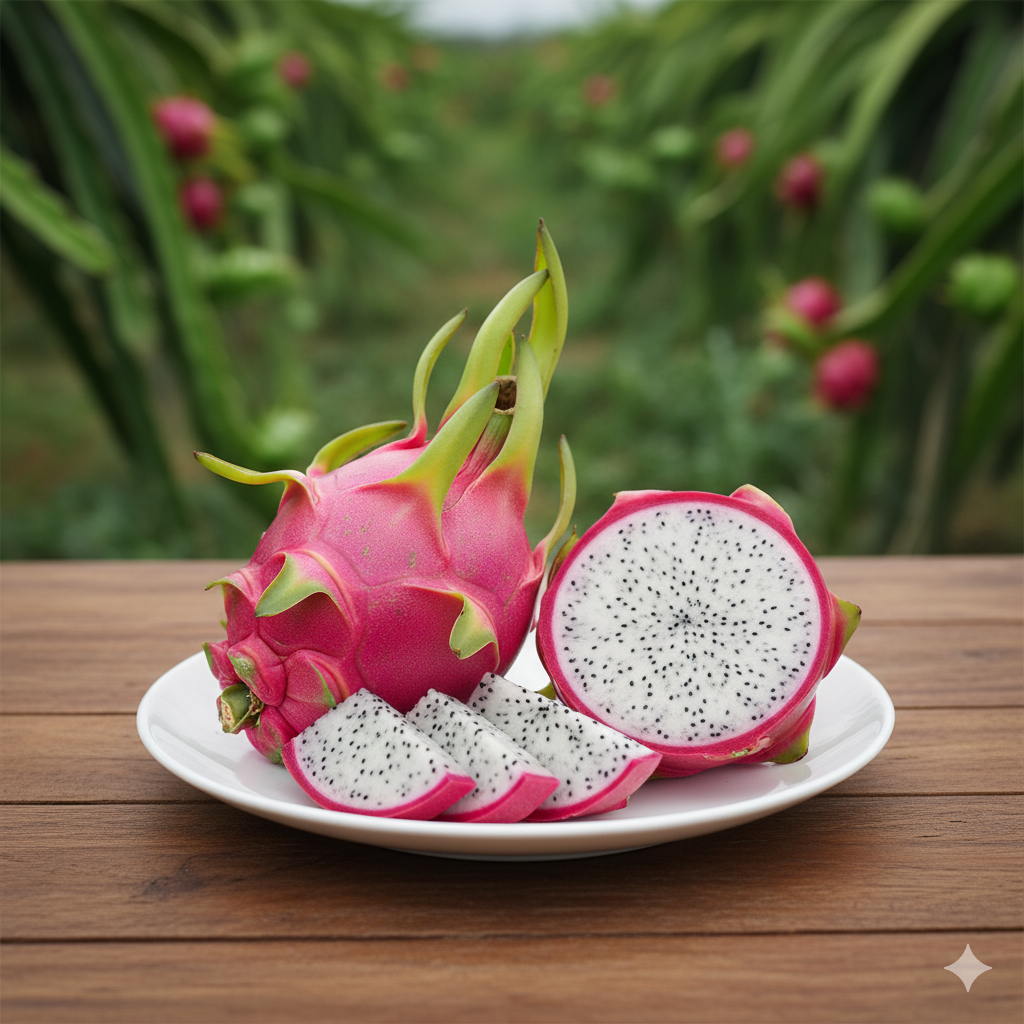
Buah Naga (Hylocereus monacanthus (Lem.) Britton & Rose) merupakan buah pitaya berbentuk bulat lonjong seperti nanas yang memiliki sirip warnah kulitnya merah dihiasi sulur atau sisik seperti naga. Buah ini termasuk dalam keluarga kaktus, yang batangnya berbentuk segitiga dan tumbuh memanjat. Batang tanaman ini mempunyai duri pendek dan tidak tajam. Bunganya seperti terompet putih bersih, terdiri atas sejumlah benang sari berwarna kuning.
Buah naga ada empat jenis yaitu buah naga daging merah, buah naga daging putih, buah naga super merah dan buah naga daging kuning. Keempat jenis buah naga tersebut mempunyai keunggulan masing-masing dan mempunyai ciri yang berbeda. Daging buah naga merah memiliki kandungan antioksidan yang lebih tinggi dibanding jenis buah baga putih. Aktifitas antioksidan pada ekstrak daging buah naga merah (Hylocereus monacanthus) menghasilkan konsentrasi yang cukup tinggi sekitar 75,4%. Daging buah naga merah memiliki banyak kandungan antioksidan salah satunya fenol dan asam askorbat yang memiliki kekuatan untuk menangkap logam sehingga dapat menangkap ion besi penyebab timbulnya penyakit degeneratif (Panjuantiningrum, 2009).
Khasiat
Buah Naga (Hylocereus monacanthus) mengandung vitamin B1, vitamin B2, vitamin B3 dan vitamin C, protein, lemak, karbohidrat, serat kasar, tiamin, niasin, pyridoxine, kobalamin, glukosa, fenol, betasianin, polifenol, karoten, fosfor, besi dan flavonoid yang beberapa diantaranya merupakan senyawa antioksidan. Kandungan buah flavonoid dalam buah naga merah dapat menurunkan kadar glukosa dalam darah. Selain itu, kandungan isoflavon pada senyawa flavonoid dapat menurunkan risiko terjadinya penyakit jantung, diabetes ginjal dan osteoporosis (Nuari et al, 2017).
Cara Pengolahan
Buah Naga (Hylocereus monacanthus) dapat dibuat dalam bentuk sediaan lotion. Tahap pertama timbang semua bahan dalam pembuatan lotio, yaitu ekstrak kulit buah naga (3%), asam stearat (2,5%), Na CMC (1%), paraffin cair (7%), gliserin (5%), trietanolamin (2%), asam benzoat (0,2%), alkohol (5%), parfum (q.s) dan aquades (ad 100). Lalu panaskan lumpang di atas water bath atau penangas air. tahap kedua masukan fase minyak terlebih dahulu dalam lumpang gerus sampai homogen, lalu tambahkan fase air sedikit demi sedikit gerus cepat ad homogen kemudian setelah itu masukan alkohol sedikit-demi sedikit lalu tambahkan ekstrak kulit buah naga (Hylocereus monacanthus) lalu gerus ad homogen. Tahap ketiga tambahkan parfum gerus ad homogen. Keluarkan dari lumpang masukan ke dalam wadah yang telah disediakan (Yanty dan Siska, 2017).
Daftar Pustaka:
Integrated Taxonomic Information System. (n.d.). TSN 907283. ITIS. Retrieved November 19, 2025, from https://www.itis.gov/servlet/SingleRpt/SingleRpt?search_topic=TSN&search_value=907283
Nuari, S., Anam, S., & Khumaidi, A. (2017). Isolasi dan Identifikasi Senyawa Flavonoid Ekstrak Etanol Buah Naga. Galenika Journal of Pharmacy, 2(2), 118–125.
Panjuantiningrum, F. (2009). Pengaruh Pemberian Buah Naga Merah (Hylocereus polyrhizus) Terhadap Kadar Glukosa Darah Tikus Putih yang Diinduksi Aloksan.
Yanty, N. Y., dan Siska, A. V. (2017). Ekstrak Kulit Buah Naga Merah (Hylocereus Polyrhizus) Sebagai Antioksidan dalam Formulasi Sediaan Lotio. Jurnal Ilmiah Manuntung, 3(2), 166-172.
Buah Naga (Hylocereus monacanthus (Lem.) Britton & Rose)
Scientific name
Hylocereus monocanthus (Lem.) Britton & Rose
Taxonomy
Kingdom: Plantae
Division: Tracheophyta
Class: Magnoliopsida
Order: Caryophyllales
Family : Cactaceae
Genus : Hylocereus monocanthus
Species : Hylocereus monacanthus (Lem.) Britton & Rose
(ITIS, n.d.)
General Definition
Dragon Fruit (Hylocereus monocanthus (Lem.) Britton & Rose) is a pitaya fruit shaped like an elongated sphere, similar to a pineapple, with red-colored skin adorned with tendrils or scales resembling a dragon. This fruit belongs to the cactus family, characterized by triangular stems that grow as vines. The plant’s stems have short, blunt spines. Its flowers resemble pure white trumpets, consisting of several yellow stamens.
There are four types of dragon fruit: red-fleshed dragon fruit, white-fleshed dragon fruit, super red dragon fruit, and yellow-fleshed dragon fruit. Each of these four types has its own advantages and distinct characteristics. Red dragon fruit flesh contains higher levels of antioxidants compared to white dragon fruit. The antioxidant activity in red dragon fruit pulp extract (Hylocereus monacanthus) yields a relatively high concentration of approximately 75.4%. Red dragon fruit pulp contains numerous antioxidants, including phenols and ascorbic acid, which possess the ability to bind to metals and thus capture iron ions—a cause of degenerative diseases (Panjuantiningrum, 2009).
Health Benefits
Dragon fruit (Hylocereus monacanthus) contains vitamin B1, vitamin B2, vitamin B3, and vitamin C, as well as protein, fat, carbohydrates, dietary fiber, thiamine, niacin, pyridoxine, cobalamin, glucose, phenols, betacyanin, polyphenols, carotenoids, phosphorus, iron, and flavonoids—some of which are antioxidant compounds. The flavonoid content in red dragon fruit can lower blood glucose levels. Additionally, the isoflavone content within the flavonoid compounds can reduce the risk of heart disease, kidney diabetes, and osteoporosis (Nuari et al., 2017).
Processing Method
Dragon fruit (Hylocereus monacanthus) can be formulated into a lotion. The first step is to weigh all ingredients for the lotion: dragon fruit peel extract (3%), stearic acid (2.5%), sodium carboxymethylcellulose (1%), liquid paraffin (7%), glycerin (5%), triethanolamine (2%), benzoic acid (0.2%), alcohol (5%), fragrance (q.s.), and distilled water (to 100). Then heat the mortar over a water bath. In the second step, add the oil phase first to the mortar and grind until homogeneous; then add the aqueous phase little by little, grinding quickly until homogeneous. After that, add the alcohol little by little, followed by the dragon fruit peel extract (Hylocereus monacanthus), and grind until homogeneous. In the third step, add the fragrance and blend until homogeneous. Remove from the blender and transfer to the prepared container (Yanty and Siska, 2017).
References:
Integrated Taxonomic Information System. (n.d.). TSN 907283. ITIS. Retrieved November 19, 2025, from https://www.itis.gov/servlet/SingleRpt/SingleRpt?search_topic=TSN&search_value=907283
Nuari, S., Anam, S., & Khumaidi, A. (2017). Isolation and Identification of Flavonoid Compounds from Dragon Fruit Ethanol Extract. Galenika Journal of Pharmacy, 2(2), 118–125.
Panjuantiningrum, F. (2009). The Effect of Red Dragon Fruit (Hylocereus polyrhizus) Administration on Blood Glucose Levels in Alloxan-Induced White Mice.
Yanty, N. Y., and Siska, A. V. (2017). Red Dragon Fruit (Hylocereus Polyrhizus) Peel Extract as an Antioxidant in Lotion Formulations. Manuntung Scientific Journal, 3(2), 166–172.